
Got a Frozen Shoulder? Here's What's Actually Going On (and What to Do About It)
If you've been waking up at 3am because you rolled onto your shoulder, or you've started dreading something as simple as putting on a shirt, you might be dealing with frozen shoulder.
It's one of the more frustrating conditions we see at Vital Action Physio. Not because it's complicated to diagnose, but because it tends to sneak up on people. One week your shoulder feels a bit stiff, and a few months later you can't reach the top shelf or buckle your seatbelt without wincing.
The good news is that it does get better. And how you manage it early on makes a real difference to how long recovery takes.
What Is Frozen Shoulder, Really?
Frozen shoulder (the medical name is adhesive capsulitis) is a condition where the capsule surrounding your shoulder joint becomes inflamed and tightens up. That capsule is a soft tissue structure that normally gives your shoulder its impressive range of movement. When it gets irritated and starts to thicken, your shoulder loses movement in multiple directions.
This is worth understanding because a lot of people assume it's a muscle problem or that they've "pulled something." It's not. The stiffness comes from deeper inside the joint itself, which is part of why stretching harder rarely helps and can sometimes make things worse in the early stages.
It's more common in people aged 40 to 60, and if you have diabetes or a thyroid condition, your risk is higher. It can also develop after a shoulder injury or any period where the shoulder hasn't moved much, like after surgery or wearing a sling.
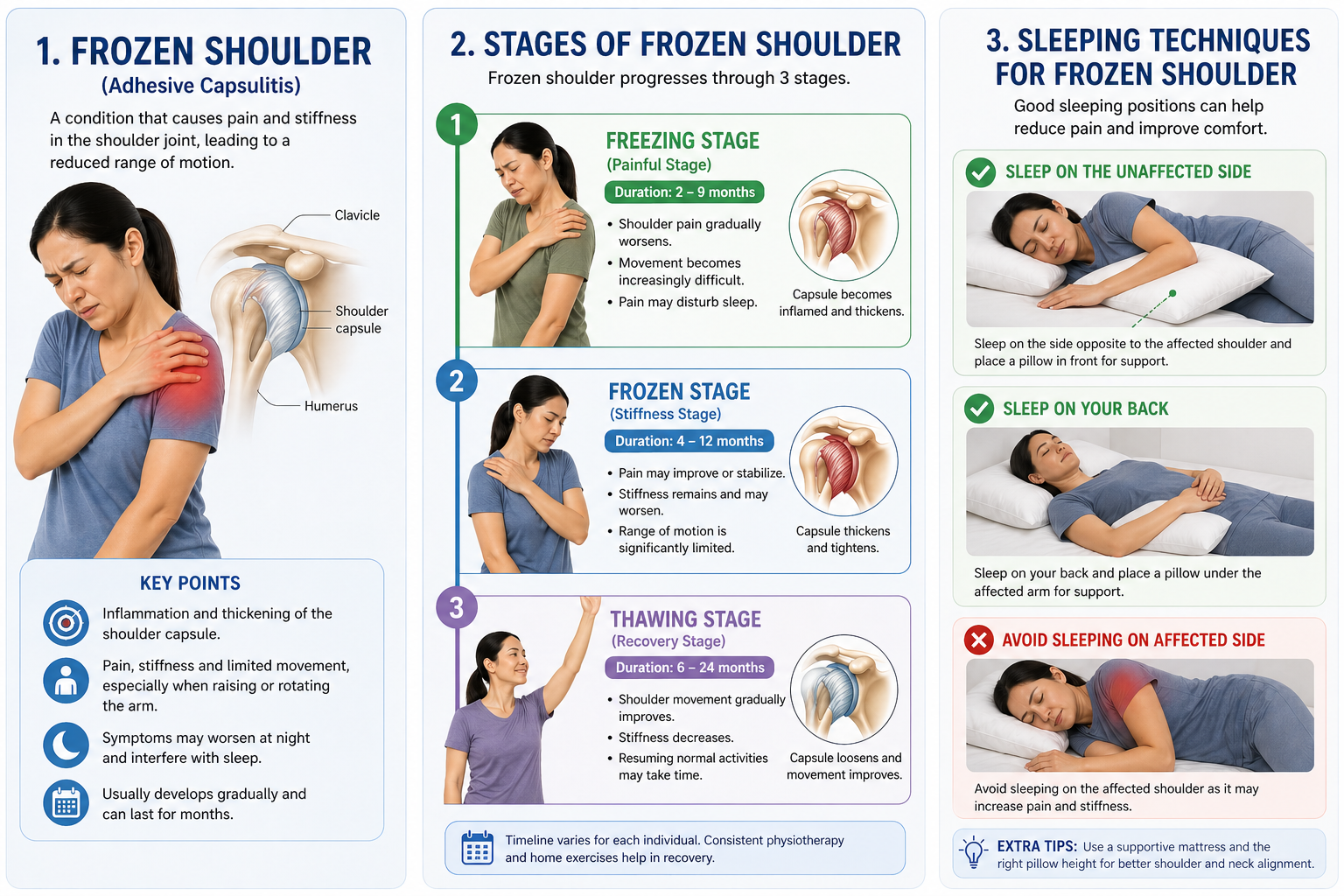
Frozen shoulder progresses through 3 stages. Understanding your stage helps guide the right treatment approach.
The 3 Stages (and Why They Matter)
Frozen shoulder doesn't just show up fully formed. It moves through stages, and knowing which stage you're in actually changes what treatment looks like.
Stage 1: Freezing (Painful)
This is the early stage. Pain gradually increases and shoulder movement starts to reduce. Night pain is common, and this is usually when people first come in to see us. The tricky part here is that aggressive stretching can actually wind things up more. The main goal at this stage is managing pain, protecting sleep, and keeping the shoulder gently moving without irritating it further.
Stage 2: Frozen (Stiff)
The pain often starts to settle a bit here, but the shoulder remains very stiff. Daily activities are still difficult because the shoulder just won't move freely. This is the stage where a structured home exercise program and hands-on physiotherapy become really important. The joint needs regular, targeted movement to start loosening up.
Stage 3: Thawing (Recovery)
Movement slowly improves. Pain reduces further and the shoulder starts to feel more functional. Even at this stage, exercise is important because the shoulder muscles can be quite weak after months of limited use.
Recovery timelines vary a lot between people. Some cases resolve within 6 to 12 months. Others can take longer. The important thing is to keep progressing with the right treatment rather than waiting it out and hoping it improves on its own.
Common Symptoms to Watch Out For
People with frozen shoulder typically describe:
Shoulder pain, often worse at night
Difficulty reaching overhead or behind the back
Trouble putting on clothes or washing hair
Reduced ability to reach for a seatbelt
Progressive loss of shoulder movement over weeks and months
If you're ticking most of those boxes, it's worth getting a proper assessment. Early treatment helps identify which stage you're in and makes sure you're doing the right things, not just the most obvious ones.
How We Treat Frozen Shoulder at Vital Action Physio
Physiotherapy is the main treatment approach. At our Liverpool and Eastern Creek clinics, treatment is built around your specific stage and irritability level rather than a one-size-fits-all protocol.
A typical treatment plan might include:
A thorough shoulder assessment to confirm the movement pattern
Education about the condition and realistic recovery timeline
Pain management advice (including sleep position guidance)
Gentle mobility exercises progressed over time
Manual therapy and joint mobilisation
Strengthening exercises once the shoulder is ready for them
A personalised home exercise program you can actually stick to
The key principle is gradual progress. Frozen shoulder responds well to consistent, appropriate movement. Forcing it aggressively through pain usually sets things back.
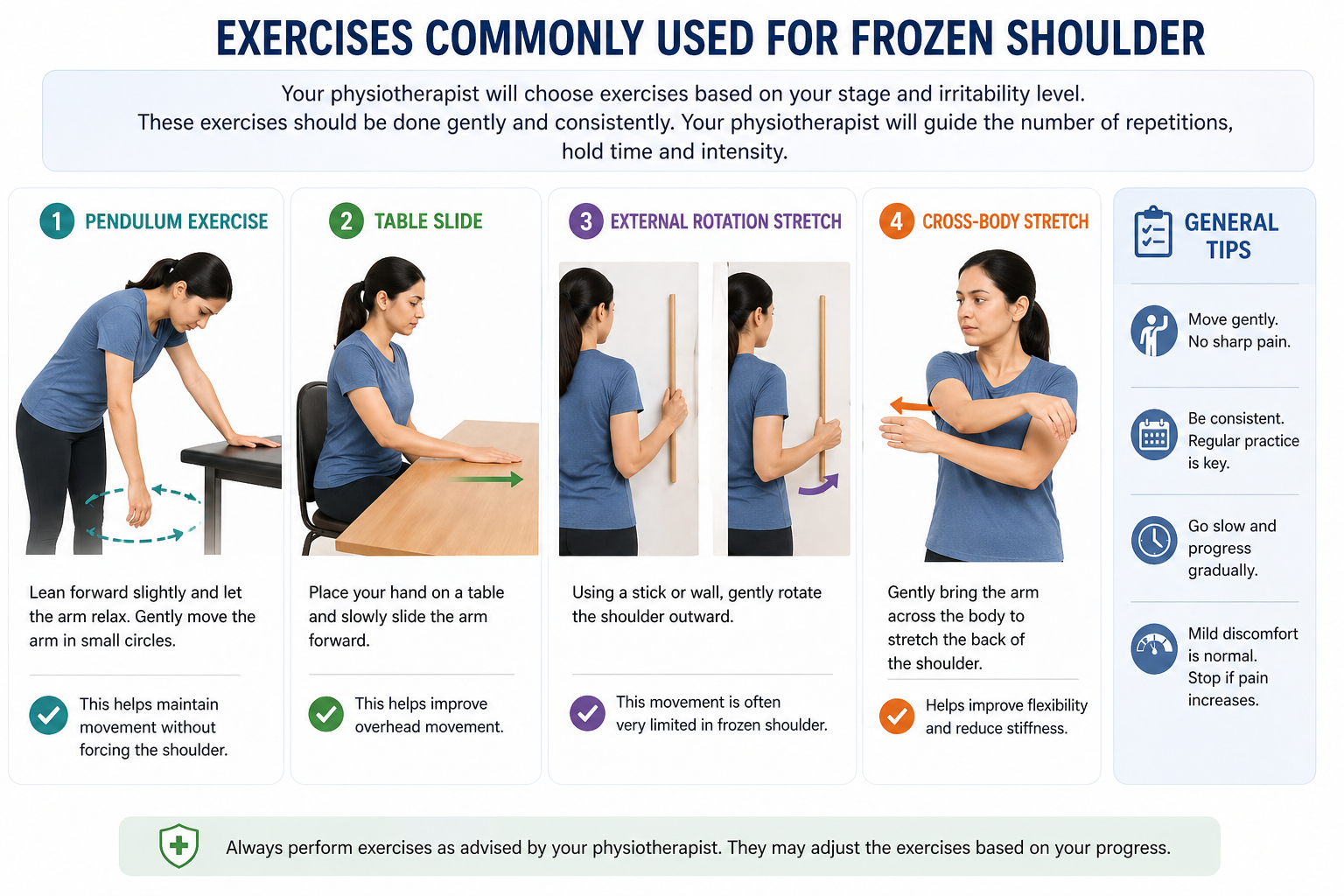
Your physiotherapist will select exercises based on your current stage and pain levels. These four are among the most commonly prescribed for frozen shoulder
Exercises That Actually Help
Your physio will guide the specific exercises based on where you're at, but some of the most commonly used ones include:
Pendulum exercise: You lean forward slightly and let the arm hang, then gently move it in small circles. This keeps movement going without forcing the shoulder, which is especially useful in the painful early stage.
Table slide: You place your hand on a table and slowly slide the arm forward. Simple but effective for improving overhead movement.
External rotation stretch: Using a stick or wall to gently rotate the shoulder outward. This direction is often the most restricted in frozen shoulder, so it needs consistent, careful work.
Cross-body stretch: Bringing the arm gently across the body to stretch the back of the shoulder.
A general rule of thumb: some discomfort during stretching is normal and expected. Sharp pain, or pain that lingers for hours after you exercise, usually means you've pushed too hard. Back off a little and reassess.
What to Avoid
A few things tend to slow recovery down:
Forcing the arm into sharp pain
Heavy lifting in the early painful stage
Repetitive overhead activity when it increases symptoms
Sleeping directly on the painful shoulder
Stopping exercises completely when things feel better
Doing random exercises from the internet without getting assessed first
That last one comes up a lot. We regularly see people who have been doing rotator cuff exercises for weeks because something on YouTube looked relevant, but they've actually been working the wrong area for their stage of recovery.
Do Injections Help?
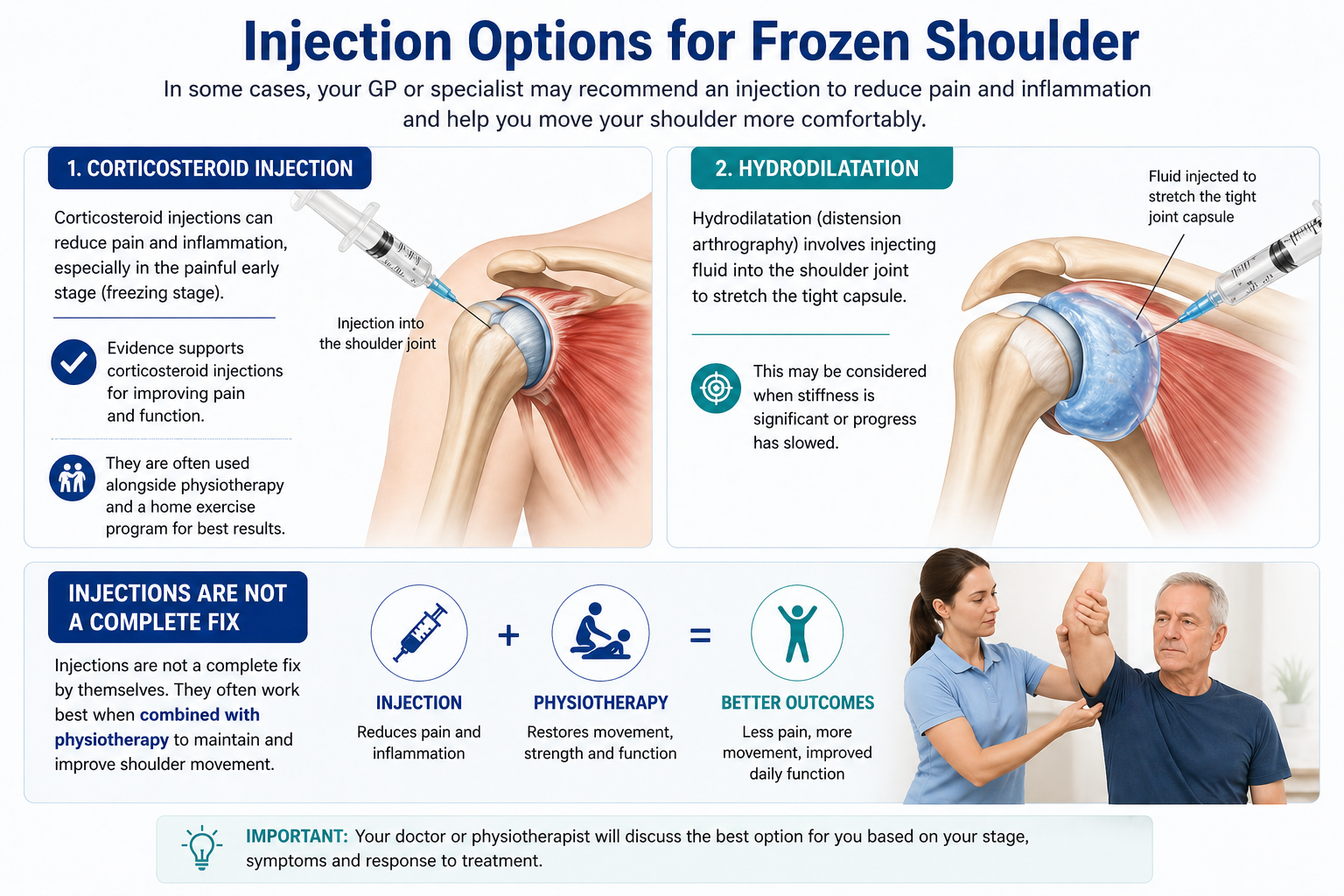
In some cases, a corticosteroid injection can be helpful, particularly in the early painful stage. The evidence supports these injections for reducing pain and improving function, and they often work well when combined with a physiotherapy program.
Another option is hydrodilatation, where fluid is injected into the shoulder joint to stretch the capsule. This tends to be considered when stiffness is significant or when progress with other treatment has slowed.
Injections on their own aren't a complete solution. They work best as part of a broader management plan that includes physiotherapy and consistent home exercises.
Injections can help reduce pain and inflammation, but work best when combined with an ongoing physiotherapy program.
Does Surgery Come Into It?
For most people, no. Surgery or manipulation under anaesthetic is only considered when symptoms are severe, long-lasting and haven't improved with a proper course of conservative treatment. Even after a procedure, physiotherapy is still needed to rebuild movement, strength and function. It's not a shortcut.
When Should You See a Physio?
Worth coming in if:
Shoulder pain is affecting your sleep regularly
You can't reach overhead or behind your back
Your shoulder is getting progressively stiffer over weeks
You have diabetes or a thyroid condition and you've developed new shoulder stiffness
You're not sure whether it's frozen shoulder or a rotator cuff issue
Things aren't improving after a few weeks of trying to manage it yourself
Getting an early assessment means you find out exactly which stage you're in, what to do and what to avoid, and how long you can realistically expect this to take. That information alone tends to reduce a lot of the stress that comes with this condition.
Book an Appointment at Vital Action Physio
If you think you have a frozen shoulder, get in touch with us. We see frozen shoulder regularly at both our Liverpool and Eastern Creek locations, and we know how much it disrupts everyday life.
If your shoulder is getting worse or your sleep is suffering, the best thing you can do is get it properly assessed so you know what you're dealing with and how to move forward.
Liverpool clinic: 94 Moore Street, Liverpool NSW 2170 | (02) 7251 1475
Eastern Creek clinic: Shop 12/2A Southridge St, Eastern Creek NSW 2766 | (02) 8834 7730
Same-day appointments are available. Book online or give us a call.